


Page 4 - emap_newsletter_V2
P. 4
eMAP – electronic EHA Medical HemAtology Program

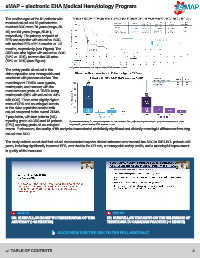
The median ages of the 51 patients who
received axi-cel and 58 patients who
received SOC were 70 years (range, 65-
80) and 69 years (range, 65-81),
respectively. The primary endpoint of
EFS was superior with axi-cel vs. SOC,
with median EFS of 21.5 months vs. 2.5
months, respectively (see Figure). The
ORR was also higher with axi-cel vs. SOC
(88% vs. 52%), as were the CR rates
(75% vs. 33%) (see Figure).

The safety profile of axi-cel in this     EFS, event-free survival; KM, Kaplan-Meier; SOC, standard of care.

older population was manageable and

consistent with previous studies. The

most frequent TEAEs were pyrexia,

neutropenia, and nausea; with the

most common grade =3 TEAEs being

neutropenia (80% with axi-cel vs. 44%

with SOC). There were slightly higher

rates of CRS and neurological events

in this older population treated with

axi-cel compared to the overall ZUMA-

7 population, with four patients (8%)

reporting grade =3 CRS and 13 patients    CI, confidence interval; CR, complete response; NE, not evaluable; ORR, objective response rate; PD, progressive disease; PR, partial

(27%) reporting grade =3 neurological     response; SD, stable disease; SOC, standard of care.

events. Furthermore, the quality of life analysis demonstrated statistically significant and clinically meaningful differences favouring

axi-cel over SOC.

The study authors concluded that axi-cel demonstrated superior clinical outcomes over second-line SOC in R/R LBCL patients =65
years, including significantly improved EFS, over double the CR rate, a manageable safety profile, and a meaningful improvement
in quality of life measures.

     WATCH                                          WATCH
DR. KURUVILLA’S IN-DEPTH PRESENTATION OF THIS  DR. KURUVILLA’S THOUGHTS ON THE RELEVANCE OF
ABSTRACT (~12 MINUTES)                         THESE DATA TO CANADIAN PRACTICE (~1 MINUTE)

                                       CLICK HERE FOR THE LINK TO THE FULL ABSTRACT

TABLE OF CONTENTS                                                                                                                                                                4

